 Skip to content


How to Measure Sleeve Length on a Dress Shirt (2 Methods + Conversion Chart)
Your best-fitting dress shirt already knows your sleeve length. You just have to read it. This guide shows you how to measure the sleeve on the shirt itself, laid flat on a table, in about five minutes. It covers the two ways shirtmakers measure (from the center back of the collar, and from the shoulder seam), how to convert one to the other, and how to check a new shirt against the size on its label.
We make every shirt to order in our own workshop, and we measure sleeves this way dozens of times a week. If you want to measure your body instead, use our body sleeve length guide with a chart by height. This page is about the garment.
The Quick Answer
Lay the shirt face down and smooth it flat. Put the end of a soft tape at the center back of the collar, right where the collar meets the shirt. Run it straight across to the shoulder seam, then turn and follow the top of the sleeve down to the end of the cuff. That number is the dress shirt sleeve length, the same number printed on shirt labels (for example the 34 in 16/34).
| Method | Starts at | Ends at | Used for |
|---|---|---|---|
| Center-back sleeve | Center back of collar seam | Cuff edge | Shirt labels (15.5/34) and most US sizing |
| Shoulder-seam sleeve | Top of the shoulder seam | Cuff edge | Tailors, pattern makers, some European brands |
Most confusion online comes from mixing these two. A shirt can measure 34″ from the center back and only about 25″ from the shoulder seam. Both numbers are correct. They just start in different places.
What You Need
- A dress shirt that fits you well in the sleeves (washed at least once, so any shrinkage has already happened)
- A soft tailor’s tape (a metal tape measure bends badly around seams)
- A flat, hard surface: a dining table works better than a bed
- Pen and paper, or your phone’s notes app
Method 1: Center-Back Sleeve Length (the Label Number)
- Button the shirt and lay it face down. Button the cuffs too. Smooth the back panel and one sleeve so there are no folds. Let the sleeve lie straight out from the body at a slight downward angle, the way it hangs naturally. Do not stretch it.
- Find the starting point. It is the center of the back of the collar, at the seam where the collar band joins the shirt. If the shirt has a back pleat or a hanger loop, it is directly above it.
- Measure across to the shoulder seam. Run the tape horizontally along the yoke to the point where the sleeve is sewn on. Hold the tape there with a finger.
- Turn and follow the sleeve. Keep the tape on the top fold of the sleeve and run it to the very end of the cuff. Do not cut across the sleeve diagonally.
- Read and round. Read the total to the nearest quarter inch. Measure the other sleeve as well; a difference of more than half an inch usually means one sleeve was not lying flat.
Tip: If you measure 34¼”, your label size is 34. If you measure 34¾”, look at 35 or a 34/35 shirt. Off-the-rack shirts are made in whole or two-inch ranges, so a quarter inch either way is normal.
Method 2: Shoulder-Seam Sleeve Length
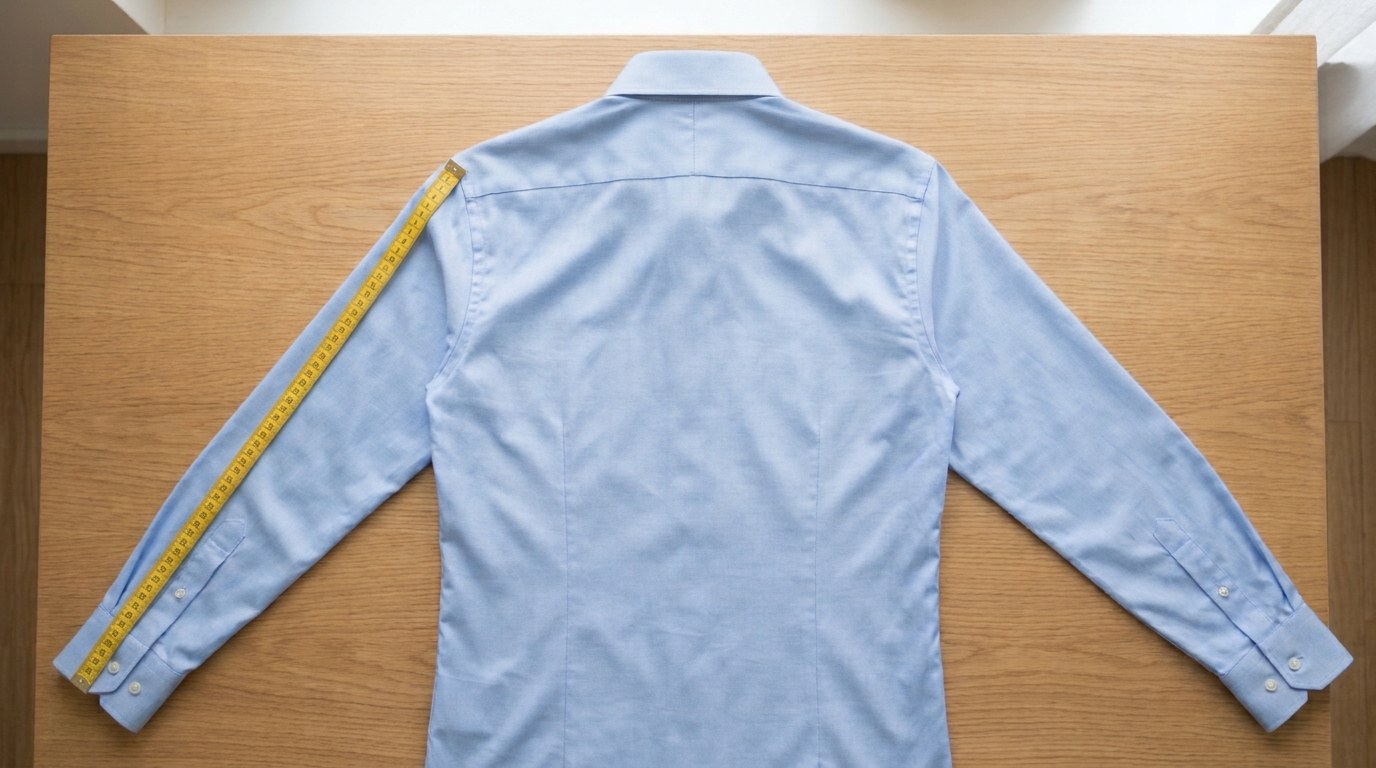
This is the number a tailor or shirtmaker uses to cut the sleeve itself. Start the tape on the top of the shoulder seam (where the sleeve is attached) and run it along the top fold of the sleeve to the cuff edge. That is it.
It matters most when you compare shirts with different shoulder widths. A shirt with a wide yoke has more of its “sleeve length” in the shoulders, so the sleeve piece itself is shorter. Measuring from the shoulder seam tells you how long the actual sleeve fabric is.
How to Convert Between the Two
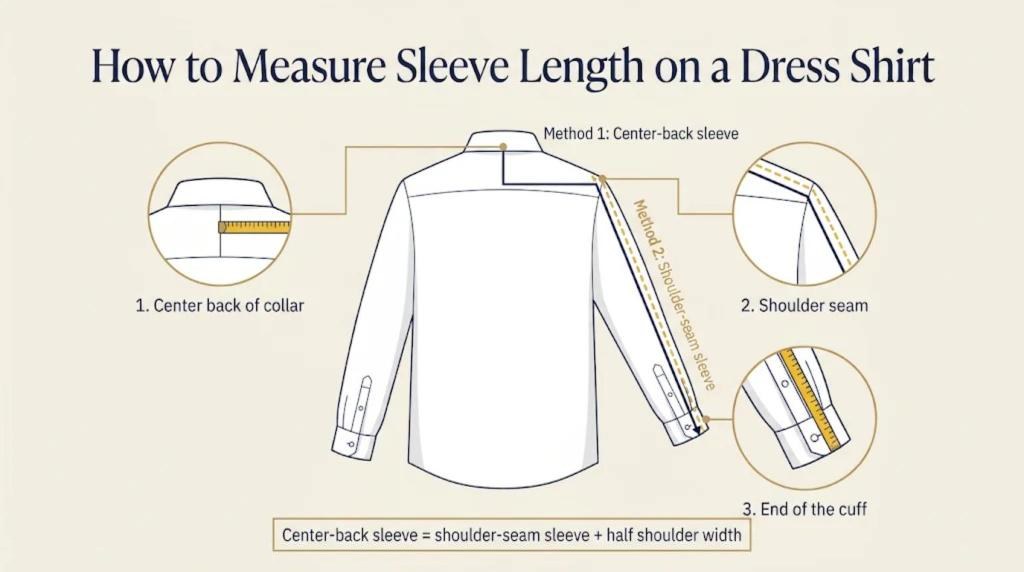
The link between the two numbers is half the shoulder width. Measure the shirt’s shoulder width straight across the back, seam to seam, and use this simple formula:
Center-back sleeve = shoulder-seam sleeve + (shoulder width ÷ 2)
| Shoulder width | Half shoulder | Shoulder-seam sleeve | Center-back sleeve |
|---|---|---|---|
| 17″ | 8.5″ | 24.5″ | 33″ |
| 18″ | 9″ | 25″ | 34″ |
| 19″ | 9.5″ | 25.5″ | 35″ |
| 20″ | 10″ | 26″ | 36″ |
This is why two shirts with the same 34″ label can feel different on your arms. If one has a wider shoulder, its seam drops down your arm and the cuff sits higher on your wrist than you expect. When you order a custom made shirt, we cut the sleeve to your shoulder width so both numbers line up with your body.
How to Check a New Shirt Against Its Label
A label like 16/34-35 means a 16″ neck and a sleeve made to fit somewhere between 34″ and 35″. In practice, the sleeve on those shirts usually measures somewhere in between. A single number like 16/34 means the sleeve should measure 34″ from the center back, usually within half an inch.
To check a new shirt, use Method 1 above and compare with the label. If it is more than about half an inch short, it will feel short once you reach forward or put on a jacket. Return it before you wash it.
Does the Cuff Style Change the Measurement?
Yes, a little, and almost no guide mentions it.
- Barrel (button) cuffs: measure to the edge of the cuff with the cuff buttoned.
- French (double) cuffs: fold the cuff back as it is worn, close it with a cufflink or a paper clip, and measure to the folded edge. Measuring an unfolded French cuff can add about three inches.
- Cocktail or turn-back cuffs: measure with the cuff turned back, the way it is worn.
French cuffs are also slightly roomier around the wrist, so many men like them about a quarter inch longer so the cuff still shows past a jacket. You can see the difference on our white twill double cuff shirt.
How to Measure a Short-Sleeve Dress Shirt
Short-sleeve shirts are sized by neck and body, not by sleeve, so the label number does not apply. To compare two short-sleeve shirts, measure from the top of the shoulder seam to the hem of the sleeve. For most men a short sleeve between 8″ and 10″ from the shoulder seam ends around mid-upper-arm, which is the classic look. You can also measure the sleeve opening flat and double it to see how wide it will feel around your arm.
6 Mistakes That Give You the Wrong Number
- Starting at the collar point or the side of the neck. Always start at the center back of the collar seam. Starting at the side of the neck can cut 3″ or more off the result.
- Measuring diagonally across the sleeve. Follow the top fold. A diagonal line to the cuff reads short.
- Measuring a shirt fresh from the packet. Cotton can shrink after the first wash, especially at the sleeve. Measure a shirt that has been washed and pressed.
- Leaving the cuff unbuttoned or a French cuff unfolded. Both change the endpoint.
- Stretching the sleeve. Lay it flat; do not pull it straight. Some fabrics give half an inch under tension.
- Copying the number from a shirt that never fitted. If the cuffs on your reference shirt always ride up, add half an inch to what you measure.
How Do You Know the Sleeve Is the Right Length?
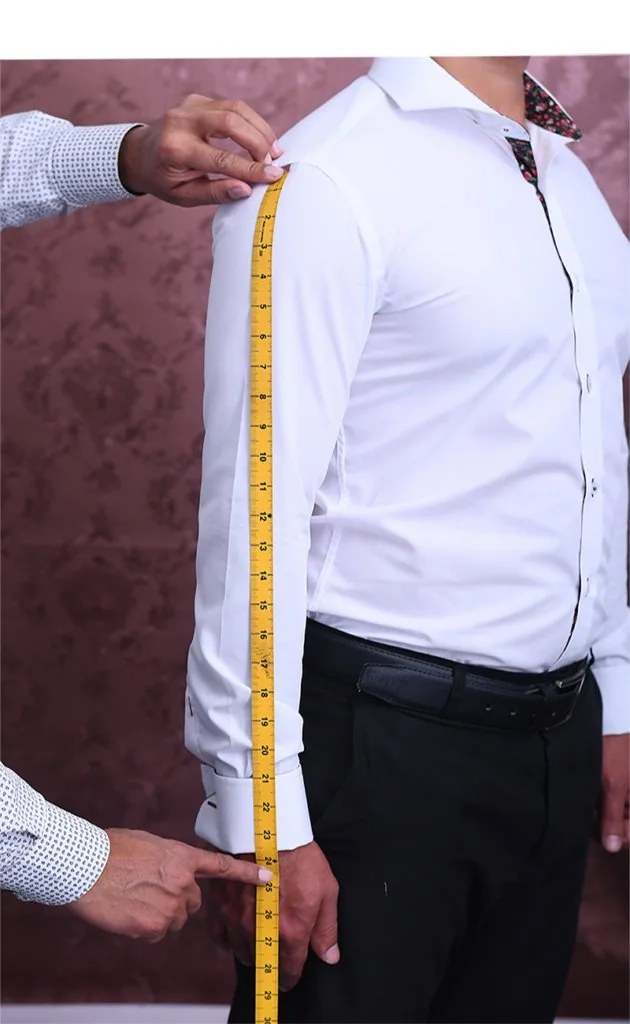
Put the shirt on, stand with your arms relaxed at your sides, and look at the cuff. It should reach the point where your wrist meets your hand, just covering the wrist bone. With a suit jacket on, about a quarter to half an inch of cuff should show. When you reach forward, the cuff should not slide more than an inch up your forearm. If you wear a watch, the cuff on that side should sit on top of it without catching.
If your arms are not the same length (one is often slightly longer), go with the longer arm. A slightly long cuff looks intentional; a short one looks like the shirt shrank.
Your Five-Minute Sleeve Worksheet
| Measurement | Where to measure | Your number |
|---|---|---|
| Center-back sleeve | Center back collar seam → shoulder seam → cuff edge | _____ |
| Shoulder width | Across the back, shoulder seam to shoulder seam | _____ |
| Shoulder-seam sleeve | Shoulder seam → cuff edge | _____ |
| Cuff circumference | Unbutton, lay flat, measure from the middle of the button to the far end of the buttonhole | _____ |
| Bicep width | 1″ below the armpit, straight across, then double it | _____ |
Send these five numbers with your order and we can match your favourite shirt exactly, or improve on it. If you already know the sleeve is too short, just tell us how much longer you want it.
When to Stop Measuring and Go Custom
If your sleeve measurement lands between sizes, if your shoulders are broad but your arms are average, or if every off-the-rack shirt is either tight in the neck or short in the sleeve, a made-to-measure shirt solves all of it at once. Our business shirts are cut to your sleeve, neck, chest and shoulder numbers and made in 5–6 working days, with free initials on the cuff if you want them. Not sure which measurements you need? Start with the size guide.
Frequently Asked Questions
How do you measure sleeve length on a dress shirt?
Lay the shirt face down, start the tape at the center back of the collar seam, go across to the shoulder seam, then down the top of the sleeve to the end of the cuff. That total is the sleeve length used on dress shirt labels.
Is dress shirt sleeve length measured from the shoulder or the neck?
The size on the label is measured from the center back of the neck. Tailors also use a shoulder-seam measurement. To convert, add half the shoulder width to the shoulder-seam number.
What does 34/35 mean on a dress shirt?
The sleeve is made to fit men with a 34″ to 35″ sleeve length. The number before it (for example 16 in 16/34-35) is the neck size.
How do I measure a French cuff sleeve?
Fold the cuff back the way it is worn, close it, and measure to the folded edge. Measuring the cuff unfolded gives a number that is about three inches too long.
Will my shirt sleeves shrink?
Cotton can shrink slightly after the first few washes, often up to about half an inch on the sleeve. That is why you should measure a shirt that has already been washed, and why we allow for it when we cut a new shirt.
What is a normal sleeve length for men?
Most men wear a sleeve between 32″ and 36″ measured from the center back. Height is only a rough guide; arm length and shoulder width matter more. Our sleeve length chart by height gives a starting point.
