 Skip to content

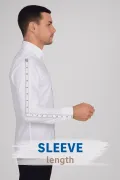
How to Measure Sleeve Length for a Dress Shirt (+ Chart by Height)
Quick answer: Dress shirt sleeve length is measured from the center back of your neck, across the top of your shoulder, and down your slightly bent arm to the point where your wrist meets your hand. Round up to the nearest half inch. Most men land somewhere between 32 and 36 inches. On a shirt label like 16 34/35, the 16 is your neck size and 34/35 is the sleeve length.
Sleeve length is the measurement we see men get wrong more than any other. People usually measure from the shoulder, or they straighten their arm and pull the tape tight, and then wonder why every shirt rides up the moment they reach for something. The fix takes about a minute and a tape measure. Here is how we do it at the cutting table, plus a chart you can use if you do not have a tape handy.
How to Measure Sleeve Length in 3 Steps
You need a soft tailor’s tape. A friend helps a lot, but you can do it alone (see the section further down). Stand straight, relax your shoulders, and put your hand on your hip so your elbow bends a little.
- Start at the center back of your neck. Find the bony bump at the base of your neck, where your collar would sit. That is point zero.
- Go across the shoulder to the shoulder point. Run the tape along the top of your shoulder to the edge of the shoulder bone, where a shirt’s shoulder seam would sit. Do not let it drop down your back or curve around your neck.
- Continue down the bent arm to the wrist. Follow the outside of your arm, over the elbow, and stop where your wrist meets your hand (just past the wrist bone). Read the number. That is your sleeve length.

If the number falls on a quarter inch, round up. A sleeve that is a touch long can be held in place by the cuff. A sleeve that is a touch short will slide up your forearm every time you move.
Dress Shirt Sleeve Length Chart
No tape measure? Height is a rough guide, because arm length mostly follows it. Use this to get close, then confirm with a tape or a shirt you already own. Men with long arms for their height should go one size up.
| Your height | Typical sleeve length | Label you’ll see |
|---|---|---|
| 5’4″ – 5’6″ (163–168 cm) | 31″ – 32″ (79–81 cm) | 31/32 |
| 5’7″ – 5’9″ (170–175 cm) | 32″ – 33″ (81–84 cm) | 32/33 |
| 5’9″ – 5’11” (175–180 cm) | 33″ – 34″ (84–86 cm) | 33/34 |
| 5’11” – 6’1″ (180–185 cm) | 34″ – 35″ (86–89 cm) | 34/35 |
| 6’1″ – 6’3″ (185–191 cm) | 35″ – 36″ (89–91 cm) | 35/36 |
| 6’3″ – 6’5″ (191–196 cm) | 36″ – 37″ (91–94 cm) | 36/37 |
| 6’5″ and taller (196 cm+) | 37″ – 38″ (94–97 cm) | 37/38 |
Off-the-rack shirts in the US are usually sold in two-inch ranges like 32/33 or 34/35, with the extra length held back by the cuff. That works if you sit in the middle of the range. If you measure 33.5″, a 32/33 will feel short and a 34/35 will bunch at the wrist. That gap is the main reason men with long or short arms struggle with ready-made shirts.
How to Read a Dress Shirt Size Label
A label like 16 34/35 or 15.5 x 33 gives you two numbers:
- The first number is the neck (collar) size in inches, usually between 14 and 18.
- The second number is the sleeve length, either as a single number (33) or a range (34/35).
Shirts sold as S, M, L and XL are a different system. They give you no sleeve number at all, and the sleeve is usually cut for an average arm of about 33–34 inches. If your arms are outside that, a lettered size will almost always miss.
How to Measure Sleeve Length Using a Shirt You Already Own
This is often the most reliable method, because it captures the fit you already like. Pick a dress shirt whose sleeves feel right.
- Button the front and the cuffs, then lay the shirt face down on a table.
- Pull one sleeve out to the side so it lies flat and fully extended. Smooth it, but do not stretch it.
- Measure from the center of the back of the collar to the shoulder seam, then from the shoulder seam to the end of the cuff. Add the two numbers together.
Check both sleeves. Cheaper shirts are sometimes half an inch different side to side, and you want the longer number.
How to Measure Your Sleeve Length by Yourself
Measuring alone is harder because you cannot see the back of your neck. Two tricks help:
- Split it into two measurements. Stand side-on to a mirror. Measure from the neck bump to your shoulder point first and write it down. Then measure from the shoulder point down the bent arm to your wrist. Add them up.
- Use a wall. Stand with your back against a door frame, hold the tape end at the base of your neck with your opposite hand, and walk the tape across the shoulder and down the arm. It takes a couple of tries, so take the measurement three times and use the number that repeats.
If both numbers disagree by more than half an inch, trust the shirt method above.
How Long Should Dress Shirt Sleeves Be?
With your arms relaxed at your sides, the cuff should stop where your wrist meets your hand. A few quick checks:
- Arms down: the cuff covers the wrist bone and touches the top of the hand. It should not reach your thumb.
- Arms forward: reach out as if shaking hands. The cuff should still cover the wrist and not slide halfway up your forearm.
- With a jacket: about a quarter to half an inch of shirt cuff should show past the jacket sleeve. If none shows, the shirt sleeve is too short or the jacket sleeve is too long.
Too long looks like the shirt is wearing you: fabric piles up above the cuff and the cuff swallows your hand. Too short is worse, because it shows every time you move your arms, and no jacket can hide it.
Small Adjustments That Change the Number
- Slim or trim fit: a narrower sleeve has less fabric to give when you bend your arm, so add about a quarter inch.
- French cuffs: the folded cuff sits a little higher and is worn with cufflinks, so many men add a quarter to half an inch for a French cuff shirt.
- A big watch: if you always wear one on the same wrist, make that sleeve a quarter to half an inch longer, or ask for a slightly wider cuff on that side. Made-to-measure shirts can do this. Off-the-rack ones cannot.
- Cotton shrinkage: a good 100% cotton shirt can lose a little length in the first few washes. Quality shirting is usually pre-shrunk, but if you wash hot, round up rather than down.
5 Common Sleeve Length Mistakes
- Measuring from the shoulder only. This is arm length, not sleeve length, and it comes out 7 to 9 inches shorter than the number on a shirt label.
- Keeping the arm dead straight. A straight arm gives a number that is too short once you bend your elbow at a desk.
- Pulling the tape tight. The tape should lie flat on the body, not dig in.
- Measuring over a thick sweater or jacket. Measure over a thin shirt or bare skin.
- Measuring only one arm. Most people have one arm slightly longer, usually the dominant one. Measure both and use the longer.
When Off-the-Rack Sleeves Will Never Fit
Ready-made shirts tie sleeve length to neck size. A 15″ neck usually comes in 32/33 or 34/35, and that is it. If you have a slim neck and long arms, or a broad neck and shorter arms, you end up choosing which part of the shirt to get wrong.
That is exactly the problem a custom made shirt solves. We cut each sleeve to your measurement, and we can make the left and right sleeves different lengths if your arms are. If you are ordering one, our full guide to measuring yourself for a custom dress shirt walks you through neck, chest, waist and shirt length too. You can also choose your collar and cuff, from a classic French cuff Giza cotton shirt to a relaxed button-down. Not sure which? Our guide to button down vs button up explains the difference.
Frequently Asked Questions
What is the average sleeve length for a man’s dress shirt?
Most men fall between 32 and 35 inches. A sleeve of 34 inches is about the most common size sold in the US, which is why 34/35 is so easy to find on the rack.
Is sleeve length measured from the neck or the shoulder?
For dress shirts, from the center back of the neck. Jacket and T-shirt sleeves are often measured from the shoulder seam, which is why those numbers look much smaller.
What does 34/35 mean on a dress shirt?
It means the sleeve is made for men whose sleeve length is 34 to 35 inches. The shirt is cut at the longer end, and the cuff holds it in place on a 34-inch arm.
What if I’m between two sleeve sizes?
Go with the longer one. A slightly long sleeve is held by the cuff and is easy for a tailor to shorten. A short sleeve cannot be fixed.
How do I convert sleeve length from inches to cm?
Multiply by 2.54. A 34-inch sleeve is about 86 cm, 35 inches is about 89 cm, and 36 inches is about 91 cm. European shirts often list sleeve length in cm on the label.
Can a tailor shorten dress shirt sleeves?
Yes. A tailor removes the cuff, takes the length out of the sleeve, and sews the cuff back on. It is worth doing on a good shirt. On a cheap one, the alteration can cost nearly as much as the shirt, so buying the right size makes more sense. Lengthening is rarely possible because there is no spare fabric.
Should my shirt sleeve show under a suit jacket?
Yes, about a quarter to half an inch of cuff should show past the jacket sleeve when your arms hang naturally. It looks finished and keeps the jacket cuff clean.
